Dunedin, New Zealand, my city - my people

Friday, November 15, 2019

United Fire Brigades Association Medal.

"A presentation."
I had a phone call a month or so ago from the chief at the Dunedin Fire station. I have been Workplace Support Chaplain there for 25, nearly 26 years. The chief asked if I had a few moments to talk and then proceeded to tell me they wanted to give me a presentation, because I "had been such a nice guy and all." He had phoned to settle on a date for this. Well we made a date and told me to invite the family. I was nervous about this and learned that it was to be a medal. Fire fighters get a gold star medal if they have served 25 years, but my few hours every week should not amount to the same sort of thing. Then I learned it was to be the "Honorary Chaplains medal", and upon checking it out on line, realised that there had only ever been 6 of them given.
In 2003 I had received a significant honour from the Governor General of NZ, the "Member of the New Zealand Order of Merit" medal. It was strange that with this one I was more nervous than that one leading up to the event. It was to be an afternoon tea, I could invite family and friends and fire fighters and retired fire fighters (Gold Watch) would be there. What would I wear? How many would be interested in coming? I was expected to give some sort of speech, what would I say? NZ is a very secular country and chaplains in fire stations are generally a thing of the past. Do I deserve this honour? So my mind went. I invited my daughter and husband; two of my brothers and their wives were keen to come and the CEO and office manager from "Workplace Support" of the Inter-Church Trade and Industry Mission. (The agency that I work for)
The ceremony
We arrived and we as a family were escorted to the "Mess" (the dining room area of the station) and had to wait for final preparations to be made upstairs in the social hall. I could see retired fire fighters arriving. In time we were led upstairs and as I entered the crowded social hall the room erupted into applause. I did not know where to look. Afternoon tea took place first then we were called to order and the "ceremony" was to start. The chief talked about the honour and spoke of why I was receiving it. He told of how before he came his experience of chaplaincy was not positive so that when he arrived seven years ago, he thought he would get rid of the chaplain. Then he met me and saw me operating and decided against it. He talked of my ability to listen and help and how he discovered that the fire fighters actually enjoyed talking with this chaplain. I was invited forward, my wife was invited forward and given a bunch of flowers then the medal was pinned to my chest. Others were invited to speak. One a retired officer, a hard, straight talking came up first. He said "David Brown is the genuine article!" He went on that everyone knows of hypocritical Christians, "there's a heap of them out there" but Dave is a "real Christian, straight up". He had known me for nearly 26 years, he was not religious, but he praised me for who I was and how I worked. There were others and then I had to respond.
It was all very embarrassing. I thanked them for the friendship, support and growth I had experienced and affirmed their commitment to serve the public and their support of each other.  I finished with Dr Albert Schweitzer quote, "I don't know what your destiny will be, but one thing I know: the only ones among you who will be really happy are those who will have sought and found how to serve." I thanked them deeply for the honour.
Really warm conversations
Then I mixed and mingled and was completely blown away by the one-on-one comments people made as they warmly shook my hands. It was a very special time for me. The retired guys enjoyed catching up with me and said some nice things. Some wanted me to join the group they have which restores old fire engines. I'd love to but you cannot do everything. Chaplaincy is a hard role because you give yourself, and it stands or falls on your openness, your character and approach to people. Your personality, genuineness and being are always on the line. I am basically shy and wonder why people could "like" me? This was a very affirming experience.
Receiving the medal

Ben says, "Dave's a genuine Christian - no BS."

The deputy reckons "We have the best chaplain."

Me responding - I warned them about the dangers of letting a preacher speak.
With my NZ Order of Merit medal added.
The family members out for dinner after. It was a double celebration. My son-in-law had received quite a prestigious national prize for "Excellence in teaching". He teaches chemistry at Otago University. My daughter took the photos.


A photo the local paper took of fire fighters and me.

Looking old and awkward about the whole thing.

Tuesday, October 22, 2019

Prepare to die right through life.

She wants to talk with you.
Yesterday morning we had a phone call from the sister of a woman who was in our old Church many years ago. She was a regular attender, then she moved out to a township on the edge of our city. She informed me that she would not be coming into our services and began attending another church nearer her home. Once when she visited my office she told me that this new Church was "more spiritual" than our Church, whatever that meant. That was thirty years ago.  Now the sister who was talking to me on the phone told me that she had terminal cancer and her time was getting close. She had asked to see me. She had attended other Churches, but she wanted someone she could talk freely to, and so she chose me. "Do you make pastoral calls out here?" she asked. "I'm retired" I said, with the unspoken implication that "these days I am not making pastoral calls". "I know." She responded, "but she is unsettled and you're the one she wants to talk with." I said yes, and made arrangements to visit her today. This sort of call always stresses me out, but more so these days. "Am I up to such a visit? Will I say the right things? Why me?" My wife and I got talking about when, if ever we will be allowed to retire? Will we have to move out of town?
I visited and it went OK
So today I went out to visit her and found her jaundiced, sitting in a chair with a morphine pump keeping her free of pain. She looked very much older than her years, but there was still a warmth, and "pleased to see you" look in her eyes. She smiled and we fell into the warm familiarity we used to have thirty years ago. We talked about life, about death and about the issues she was concerned about. I held her hands and we prayed.  I had been stressed about it, but as I shared with her I felt a relaxed confidence and freedom. Such visits are often a lovely experience. There is no play acting, no BS, just basic honesty. I came away wondering why I got so stressed in the first place.
Prepare to die...
I was working on creating a wheelbarrow out of broken bits yesterday afternoon and stewing on the visit ahead. I wondered about what she could be unsettled about. That got me thinking about death and my experiences in hospital earlier this year when a number of doctors, one after another, warned me of possible terminal outcomes, if they found cancer. I thought about my reaction then. I found I could look back on life with a good deal of gratitude, a sense of fulfilment, and while I would not want to die, I felt I had enjoyed a good life, and could not feel that I had been short changed.  But that feeling of being at ease with my possible demise grew out of purposeful living. I was grateful that I had received great examples of good healthy values and purposes in life. These had led me into constructive living and relationships. I got to thinking that in a sense we cant wait for impending death to prepare for death. We prepare for death by the very quality of our day to day living. When we live well, I suspect it is easier to die well. (I hasten to add that this, for me, has nothing to do with any eternal reward or punishment. - Whatever happens or does not happen, its really about how we feel about our living as we prepare to "let go".)
Steve Covey in his book "The seven habits of successful people." suggested that we can sort out our basic principles by imagining our funeral and thinking about what we would like various people to be able to say about us - our family, our workmates, people in our community and our friends. When we decide that, then we can more clearly see our values. Once they are decided, we be sure to build them into our living. I've never done that exercise, but it does make the point that we prepare for death best, by truly living by the deep values we hold. When death comes, as it inevitably will, we can then look back with few regrets. 


A couple of days ago we drove north for two hours to spend time with my brother and his wife. Throughout the drive I was struck by the impressive scenery - this was one view I often would have missed.
On the way home we stopped on the foreshore to eat fish and chips. I love the light hitting the clouds in the late evening sun. 

Saturday, October 19, 2019

We are one with nature.

Genesis has us as a part of the natural world.
In the second creation story in Genesis in the Bible, the myth has God forming "man out of the dust of the ground." In this way the story tells us we are part of the nature we live in, made from the mud!

St Francis of Assisi 
St Francis of Assisi is well known for three things. He took a vow of poverty and cared for the poor and the needy. He had a love of animals. Tradition had it that he talked with the animals. Churches sometimes have a "bring your pet to Church" day when they celebrate St Francis. But thirdly, he identified with the natural world. He wrote as if the natural world was part of his family. One man commenting on the words of the hymn he wrote below said, "For a man who never married, Francis had a big family." - Sister moon - Brothers wind and air - Sister water - etc.


O Most High, all-powerful, good Lord God,
to you belong praise, glory, honour and all blessing.
Be praised, my Lord, for all your creation and especially for our Brother Sun,
who brings us the day and the light; he is strong and shines magnificently.
O Lord, we think of you when we look at him.
Be praised, my Lord, for Sister Moon, and for the stars
which you have set shining and lovely in the heavens.
Be praised, my Lord, for our Brothers Wind and Air
and every kind of weather by which you, Lord, uphold life in all your creatures.
Be praised, my Lord, for Sister Water, who is very useful to us,
and humble and precious and pure.
Be praised, my Lord, for Brother Fire,
through whom you give us light in the darkness:
he is bright and lively and strong.
Be praised, my Lord,
for Sister Earth, our Mother, who nourishes us and sustains us,
bringing forth fruits and vegetables of many kinds and flowers of many colours.
Be praised, my Lord, for those who forgive for love of you; and for those
who bear sickness and weakness in peace and patience
- you will grant them a crown.
Be praised, my Lord, for our Sister Death, whom we must all face.
I praise and bless you, Lord, and I give thanks to you,
and I will serve you in all humility.
-- St. Francis of Assisi
Richard Rohr
I have just finished reading Richard Rohr's book, "The Universal Christ". I find Richard Rohr easier to listen to than to read. His active mind seems to dart from one thing to the other. But Richard Rohr sees creation as the original "incarnation". Creation, a blade of grass even, is an expression of God and a part of God's life. 
Tane Mahuta Guide.


Our passionate Kauri tree guide among her "family" - the NZ bush.


Plum blossom waiting for our return from holiday.

The woman in this photo was an inspiration. We have in Northland of New Zealand many forests with Kauri Trees. We visited recently and discovered a shop selling Kauri wood souvenirs made from Kauri wood that has been buried in swamp land, for 45,000 years and then dug up and used. It is mind boggling to think of. We also visited a famous big Kauri Tree named Tane Mahuta - "lord of the forrest". There has been a disease harming Kauri Trees so we had to wash our boots and stay on the track when we went to visit this mighty tree. There we met a guide who gave a talk about the tree and other trees around it. She was passionate about Tane Mahuta. This big tree was growing in the life time of Jesus. It has a big girth and in its foliage at the top of the tree, there are at least 150 other plants, some of them trees in their own right. She talked as if this mighty tree was her relative. She was delighted to tell us this tree was healthy, and passionate about the Kauri in New Zealand. She pointed out a tree behind her which was a her "baby", only 1500 years old and already taller than Tane Mahuta. (I was trying to photograph this tree when I had her in the picture, still passionately talking about her beloved trees.) They were, for her, part of her family, such was her spiritual connection with nature. 
Spiritual connection with nature.
I have experienced this connection. When tramping feeling at one with the bush, birds and brooks. I sometimes find myself talking to the plants beside the path, or a mountain daisy still blooming in the cold air of a mountain top, or even the hill I'm climbing. I have "my mountain" (Mount Cargill) I love to climb and enjoy its various moods. When I have chopped a tree down, I feel sad for taking its life and apologise. I love it when little fantail birds seem to follow you through the bush and I talk to them. When, in the past, I have killed animals for meat, I have done it with a deep reverence, and thanksgiving for a life given up for me. 
These days when our natural world seems under threat, I have enjoyed lately being reminded of our essential connection. It's a great experience to hold on to, it deepens our experience of life, and is important if we are going to be able to stop the destruction that's happening.  

Sunday, October 13, 2019

Appreciation important....

"Please can you...." x 3
We returned home from our holiday on a Saturday evening. We did not go to our local Presbyterian Church that first Sunday. On the Monday we heard that a lady from our old Church had died on the Sunday evening. When I first heard, I thought, "I might be asked to conduct that funeral." It was not that I wanted to do it, but that our old church currently is without a minister, and her husband had expressed a wish that I take his funeral. All day Monday I half expected a call, and by the evening I relaxed, thinking that I had escaped the responsibility. First thing on Tuesday morning the Funeral Director rang, and asked if I could lead the funeral on Friday. I accepted the job and began making preparations. 
On the Wednesday evening I had a call from the Session Clerk of the local Church. There had been mix up in the preaching roster. The minister scheduled to lead the service was expecting her date was the next Sunday, so there was nobody able to lead the coming Sunday's church service. Would I step up to take it please? I thought of all the work involved in the funeral, the short amount of time for preparation and the fact that we were scheduled to pick up our daughter and husband at the airport during Church time and initially said, "No".  I explained why. She graciously said, "Don't give it another thought." but I picked up a hint of desperation in her voice. She was going to try the Interim Moderator, and technically speaking it was his problem. I hung up and then felt guilty. I thought, "No other minister is likely to be willing to lead the service on such short notice." I did not think our Interim Moderator would.  So I rang her back. I was right, he had not agreed to take it, so I agreed to lead it. 
While we were away we had received an email that told us of a congregational meeting that was to be held on the following Monday night, to think about the future of the Church. A representative of the Presbytery was going to facilitate it. Well a few minutes after I had agreed to lead the Sunday service I received a call from the Interim Moderator to say the facilitator had chosen not to do it (for reasons to do with Presbyterian hierarchy that I did not understand) would I please facilitate the night? I know that I am good at facilitating groups, so I agreed. Here I was a retired minister, back from holidays and within a few days I had ended up with responsibility for three substantial events! Also in the midst of all this I had a phone call asking me if I would accept "team leader" responsibilities in the chaplaincy organisation - they said "there was nobody else they thought suitable". 
I do not take leadership of such events lightly. Each funeral I put a lot of preparation into, with at least two sessions with the family involved, extra visitation and careful thought.  Every church service I lead I put a lot of preparation into. I do not use notes on the day, but I have written out and planned the service several times in preparation. I like to use songs, power points, video music and other readings to prompt thought on the topic. I have learned also that facilitation requires careful thought about the process for the session, and how to get everybody talking freely together. So, apart from my normal chaplaincy work, from Wednesday night until Monday night I worked full time, probably doing more hours than most people would do in a week. I was prepared to do that. It was all voluntary work with no payment involved. But I hated having to do stuff on short notice. I hate standing in front of people, with the feeling that you might not have prepared fully.  It was a period of intense stress for me. I did all three well but come the Tuesday morning after the congregational meeting, I was exhausted, and another busy week was starting.
Somehow disappointed...
All three events were not my responsibility, yet I had accepted them to help people out in a desperate situation.  I did all under intense pressure at short notice. The thing that disappointed me was that I received no real thanks for stepping up! It was just assumed that I would! I felt used! We have since been quite busy doing other things for the church, and today included the Annual General meeting for the Church. (e.g. at 9p.m. last night we finished the process of preparing, painting and installing a new door in the church hall.) Tonight it all seemed to catch up on me, and I felt used, taken for granted and depressed. 

I do not do things to receive "thanks".  Till my dying day I will probably still say "yes" to requests for help.  But a bit of gratitude expressed helps you to feel better about the stress involved. When somebody expresses thanks for going the extra mile, it just helps your demeanour. It means that somebody noticed the extra effort involved. When those who knew it was short notice and extra service above and beyond the normal, did not recognise it with appropriate gratitude, I felt just used and abused. You're already tired, so it can easily dishearten you and bring a level of depression. 

I hope I remember to say thanks to those who go the extra mile for me.  A lesson learned.     

Sunday, September 1, 2019

A sense of "Sacred Place".

Silenced by the place
Years ago I was fortunate enough to go with friends to visit Uluru, or Ayres Rock and Kings Canyon in central Australia.  At Uluru three of us jogged around it at sunrise. (It is about 9k around) As we ran we burst into singing a chorus or a verse of a hymn. It felt sacred. A friend and I climbed it, though even then there was unease about climbing "the rock". My wife and I walked around it in the early afternoon. There was a patch where in a shallow cave you could see markings on the wall that showed Aboriginal habitation from thousands of years earlier. At Kings Canyon we walked around the top and at sunset we came across a group of people sitting in silence, watching the sun sink over the desert. Both places gave that sense of the passage of time, of life and the mystery of life itself. It "forced" a sense of reverence/respect to come over you. There have been similar experiences in other places. As I looked into dwellings that were thousands of years old at Scara Brae on the Orkney Islands, and walked among the circle of standing stones nearby, the same sense of awe pervaded me. When I tramp up Arthurs Seat in Edinburgh and look at the city underneath and muse on all the changes these rocks have witnessed, I wonder at humanity's journey and creation itself. I recall standing outside the Houses of Parliament in London and thinking of all the debate, drama and decision making that has gone on there to produce the democracy, the freedoms and rights we have in the West. There are many places that invoke that sense of awe, often because of the things that have happened there. My wife and I yesterday visited such a place.
Treaty House

Carving on the bow of ceremonial canoes


The Treaty of Waitangi
When New Zealand was "discovered" by Europeans in the 18th Century, Maori lived here in tribes spread throughout the islands of NZ. Europeans began to move here and establish themselves. Missionaries, whalers, traders good and bad arrived. Inevitably trouble between the two cultures broke out. In the early 1830's a representative of the English Crown (Busby) was sent out to help bring order. A Confederation of Tribes - or at least their tribal leaders established relationships and a flag was even designed so that other nations knew that New Zealand was a nation, governed by Maori tribal leaders. More Europeans came and so the English crown decided a Treaty had to be established between Maori and English. A Governor Hobson arrived on an English navy ship to preside over matters. A document was drawn up, Maori leaders called together and signatures gathered. This was on 6th February, 1840. Copies were made and sent around the country, where other tribes' leaders signed them.  Not all tribes were reached or signed the document, but enough for England to declare New Zealand one of its colonies and a special partnership with Maori established by this important document.
Document difficulties and disastrous departures.
For it's time it was a great document declaring a partnership with Maori and the Crown. But there were difficulties. There were significant differences in Maori and English understandings of "ownership" of land. This brought problems as governing bodies acquired more and more land. There were differences in understanding as the English version was translated into Maori. Maori seemed to be promised "authority" and the expressions used did not mean the same in Maori as in the English. There were wars, confiscations of Maori land and injustices. The Treaty was not adhered to by the settlers and the Governing bodies. There continued to be breaches of the treaty right through to the present time. Having said that, the Treaty brought about better race relations between settlers and indigenous people than in most other colonising situations. It was and is an important document. In the second half of the twentieth century, there was a growing recognition of the Treaty breaches and readiness to re-establish the essential partnership between Maori and European in NZ. We call ourselves a "Bi-cultural Country" and more and more the Maori culture is finding an important place in New Zealand society. (Of course we have many other cultural groups in NZ but ideally Maori are recognised by all as the "Tangata Whenua" - the people of the land.)  I have grown up as this resurgence of Maori Culture has been happening and the renewed recognition of the place of the treaty is being established. The above is a very much abbreviated introduction to "The Treaty of Waitangi."
The "sacred" place.
Jean and I have been holidaying. We drove north from Dunedin to Christchurch and caught up on family there. (The Maori word for "extended family" is "Whanau" and is becoming a real part of New Zealand's spoken English language.) We flew across Cook Strait to Wellington and saw more whanau there. We caught a scenic train ride to NZ's biggest city Auckland (We really do live in a beautiful country) then went by car further north to the beautiful area known as The Bay of Islands. This was our first visit there. It is there that Waitangi is to be found, the Treaty Grounds. There is a Museum, the original house where the English Diplomat, Busby was living, a Maori Meeting House and a significant flagpole. Busby's house (named now "The Treaty House") was where the treaty was drawn up. The new Governor Hobson was to establish himself so he signed on behalf of the crown.  The Flagpole has three flags flying upon it. The original Maori Confederation flag; the New Zealand Flag and the British Union Jack. The flagpole marks the actual spot where the "Treaty of Waitangi" was signed. The treaty established NZ as a place where diversity of culture was to be recognised, and it still stands as a "North Star", an ideal vision for New Zealand as a society. So yesterday we travelled slowly through the museum reacquainting ourselves with the Treaty's history. We walked almost reverently up a grassy slope to the Treaty House and I sat at the table where the treaty was finalised. We then watched a Maori welcome at the Meeting House and went down to the flagpole marking the spot where the signing took place. We went to the beach where Governor Hobson landed and explored ceremonial war canoes. It was for me a pilgrimage. I am a proud New Zealander. I have had a growing appreciation of Maori culture. In our family we have children with Maori in their ancestry. I love the values that the Treaty in its day endeavoured to express and establish. So I felt that the time we spent at the Treaty Grounds was one of those special times where we walked on "sacred ground". I am grateful to have visited and really do love my country and its people.

Ironically at Piahia, the township closest to the Treaty grounds we called at a shop owned and run by an Asian man. We were wandering around looking for bargains and heard raised voices at the counter. A Maori man had taken exception at something the owner had done, and was ranting threateningly at the Asian man. Some of what he was saying was racist anti-asian ranting, and he was looking for a fight. The Asian man remained calm but did not back down. (I kept hoping he would just shut up and let the other man run out of bluster.) He even invited the Maori man to come back at the end of business and they could "sort it out". i.e. fight. We stayed in the shop moving closer to the counter hoping that our presence would stop any physical confrontation. At one stage the Asian man said, "This is my country too!" The Maori responded, "This is my town!" followed by more threats... Eventually he left after a mate came in to encourage him to stop. The Asian man had his phone out and was threatening to phone police. We wondered if the aggressor was on drugs of some kind. ... I love my country; I love its ideals. But I am deeply sad that New Zealand like many places still has many problems. Even at my age, I still want to be part of the solution in some small way.   
   

Thursday, August 22, 2019

"Cracked!" though not insulted.

My daughter sent me this card (and a book) for Fathers Day that is coming up in NZ in a couple of weeks time. I appreciated the message.

The book looks interesting. One of my favourite authors is Karen Armstrong and it is called "The lost art of Scripture - rescuing the Sacred Texts." It discusses the sacred texts of various religions and how we understand and use them. But it was the card that intrigued me. On the front it reads, "Blessed are the cracked for they let in the light." Part of my daughter's message inside the card read, "I saw this card and present ... and thought of you! :) 'Cracked' in terms of the world's expectations but working to let in the light! Thank you!" 

When you call somebody "cracked" in NZ it is often an insult - it implies that they are not 'right in the head', 'different' or 'strange'. I'm certainly 'different' but it seems my daughter "gets" me. 

I hope Prue does!
I was asked if I could mentor a trainee chaplain. I warned my CEO that I was not orthodox in my theology and that my approach to my work as a chaplain was also a bit different. So I have taken this lady (named Prue) with me as I have visited the firefighters. Where ever we have gone the fire fighters have teased me. There has been much laughter and joking about me as a chaplain. I came away wondering what this budding chaplain thinks of my relationship with these guys and what prompts the wisecracks. Of course there has been some serious discussion, but the guys love to seize upon the opportunity to try to embarrass me in front of this new visitor. I hope Prue understands that I love the firefighters and I think they love me. The joking is an expression of that love. A person had come down from "Head Office" and was doing presentations to the fire fighters about mental health and psychological wellbeing today. She came into the afternoon tea room and her comment to me was "I have heard a lot about you this afternoon!" All I had time to say was, "Oh dear."  When I visited a suburban fire station I heard that during the lecture, people had commented on my presence in a positive way. - I hope I do "let in some light" for my fire fighters.   

Sunday, July 28, 2019

"You keep talkin' to the big fella upstairs, I'll deal to your trees"

Trees
At our house we have an acre of ground. There is the house section with lawns, apple and plum trees. Then you can walk down the back path through to the vegetable garden where we have a hen house, pear and apple trees and garden plots, then an open paddock. There are sheds where we house garden tools and other stuff. Up against those sheds on the border between house area and vege garden there were four big trees, a twisted eucalyptus and three fir trees, growing quite high. They had got to the stage of shading us, the vege garden and our neighbour's section at different times in the spring and summer months. 


"The guys at the station ought to deal to those trees!"
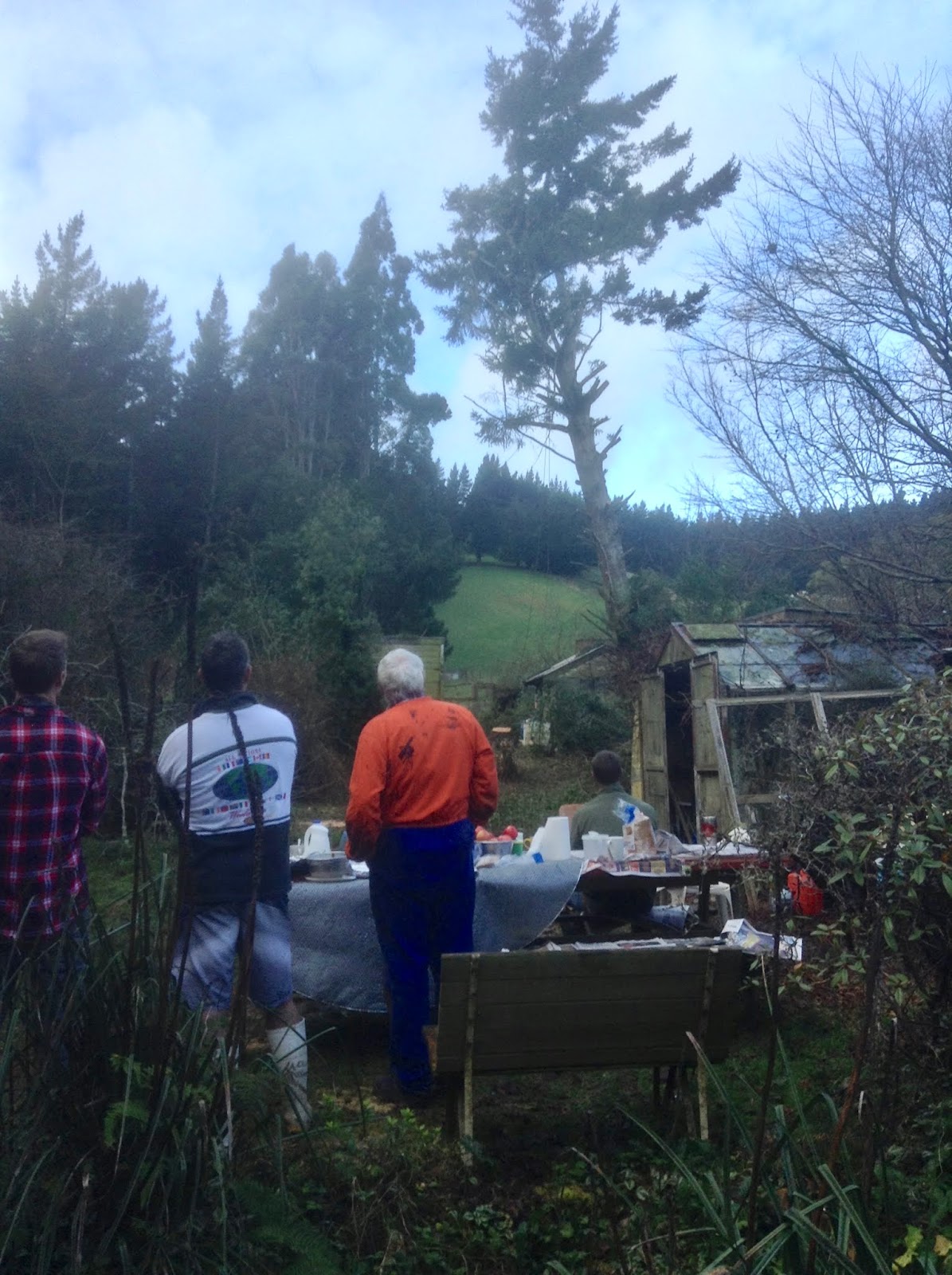
When I was in hospital earlier this year a retired fire fighter called around at our house to see how I was. I am chaplain to the Dunedin fire fighters. As he was talking with my wife he looked down the back and exclaimed, "The guys at the station ought to deal to those bloody trees." He had been part of a group of fire fighters who years ago came and dropped two big trees for me. He rang a friend at the fire station, and he started the discussion with potential helpers. One fire fighter named Peter was quite well known to be an expert at dealing to trees and he was asked to look into it. Among other things he does at the fire station, he drives the "ladder", the fire pump that has a high rise turn table ladder on the back. I got a phone call one day from an officer to say the "ladder" was going to come out to look at the trees. Pete arrived with another firefighter, and they came around and looked thoughtfully at the trees. It would be a tricky job to drop them without them crashing into sheds, or henhouse. "We could do it Dave, we might make your chooks permanently free range though!" he joked. I said that I was not asking them to do it, that I could hire an arborist to do it. "It'll cost you thousands, we'll deal to it." A few weeks went by and he chatted about it on one of my visits at the fire station. He'd have to climb up them, and cut branches off, and maybe cut them down bit by bit. "I don't want anyone to get hurt doing this." I protested. "Nah Dave, I don't want to get hurt either, leave it to me." From then on every time I protested his standard response was, "You keep talkin' to the big fella upstairs, I'll deal to your trees. It'll be alright!" In due course he arranged to come out on a day off and begin the process of planning the trees' demise. He arrived and with ropes and chainsaw, climbed the trees, taking off some branches. He eventually swung over to the Eucalyptus tree and began to cut it down in pieces. At a certain stage I suggested that he could drop it in one piece, and that he did, dropping it into our backyard.  We both cut it up and at times during the next few rainy days, my wife and I transported the pieces to a place where they could be split up. 
The special day.
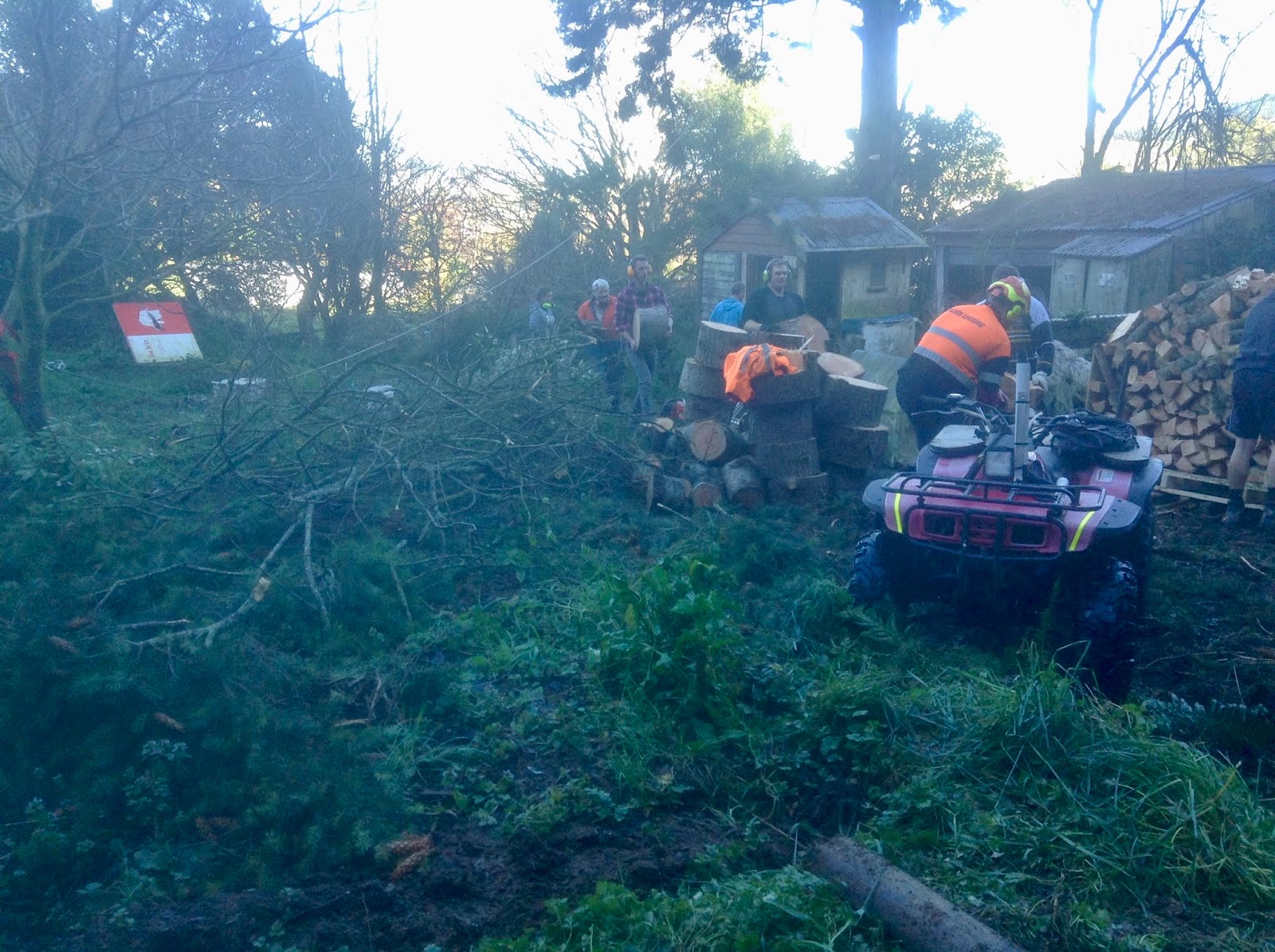
He then rang telling us he would be out with "a few mates" the next Wednesday to deal to the next three trees. "How many mates?" I asked, "we need to know how much lunch to provide." "Don't worry, we'll bring a barbecue, just make sure a kettle's boiling." On the Wednesday he arrived with some mates, and eventually during the day a total of about twelve of his fire fighter mates came. They had a wood splitter, chainsaws, ropes and harnesses. I repeated that I did not want anyone to get hurt, and Pete again responded with, "Just keep talkin' to the big fella upstairs an' we'll deal to the trees!" So they began. A group began the job of splitting the eucalyptus disks, while Pete and others trimmed branches off the first easiest of the trees, and readied it to be downed. It came down, and they descended upon it with chainsaws, and everything was transported to the splitting crew who stacked the split firewood. I joined in, really enjoying myself, pleased that these days I feel fit enough to work hard.  As fire fighters arrived they would yell out to Peter up the tree asking what they should do. His answer was, "Find a hole and fill it." This they did. It was a great feeling being part of this really motivated hard working group going about naturally, without fuss as a team. The last tree was the widest, the heaviest and in the most awkward position. Peter told me, "You know that they're putting sticks down where they think it will end up?" "Oh" I said. "At least one of them is on y'r house roof!" he continued with a grin.  Everyone stopped working to watch the last tree come down. Some had to leave to do "the school run", that is, pick up their kids from school. They delayed leaving till the last tree dropped. A young fire fighter who had tree felling experience was left to chainsaw it. He was nervous and checked with Peter several times. They had a "turfer" with a wire rope to pull on the tree to help it fall in the right direction. It came down with a big thump, and everyone clapped. There was relief that it had dropped safely, and the crews descended upon it to dissect it.  Pete stood on the tree like a conqueror, "I told you that if you kept talkin' to the big fella, I'd sort your trees! No worries!" he said triumphantly. "You were nervous and just as relieved as me!" I responded.
The last tree tumbles.

They kept working till they had to go back on night shift. Peter and a group were back the next day to complete the splitting and stacking before we finished with a special morning tea. I was a bit stiff and sore from hard heavy work, but I really enjoyed working with these  guys.  That sort of team work is part of their fire fighter culture. I thanked Pete and the guys for their effort. Quite a number came and shook my hand or gave me a thumbs up as they left. "Pay back Dave." Pete said, "You've done so much for us." He told me he had no trouble getting people to help when they knew it was for me. I felt deeply humbled and grateful.  While I have cut down a few trees in my life, I knew I could not do these ones. Pete was right, it would have cost me a few thousand dollars to pay an arborists to do it. The day had many humorous mini adventures. Pete's ute sank to its axles in the neigbour's paddock. A branch nearly smashed a shed roof. Peter, hanging on ropes in the tree, let out a loud string of expletives and we laughed wondering what the neighbours thought. There was "discussion" about how to stack wood. It was for me a special time I will always look back on with deep gratitude. I appreciated the job being done, but really enjoyed the friendship.